The Problem with Generic AI Content
If you've tried ChatGPT or similar tools for marketing content, the experience is probably familiar: the output is grammatically correct, reasonably structured — and completely generic. It could have been written for any business in any industry. That's because general-purpose AI models don't know your brand, your audience, your voice, or the particular way you communicate that makes your content recognisable as yours.
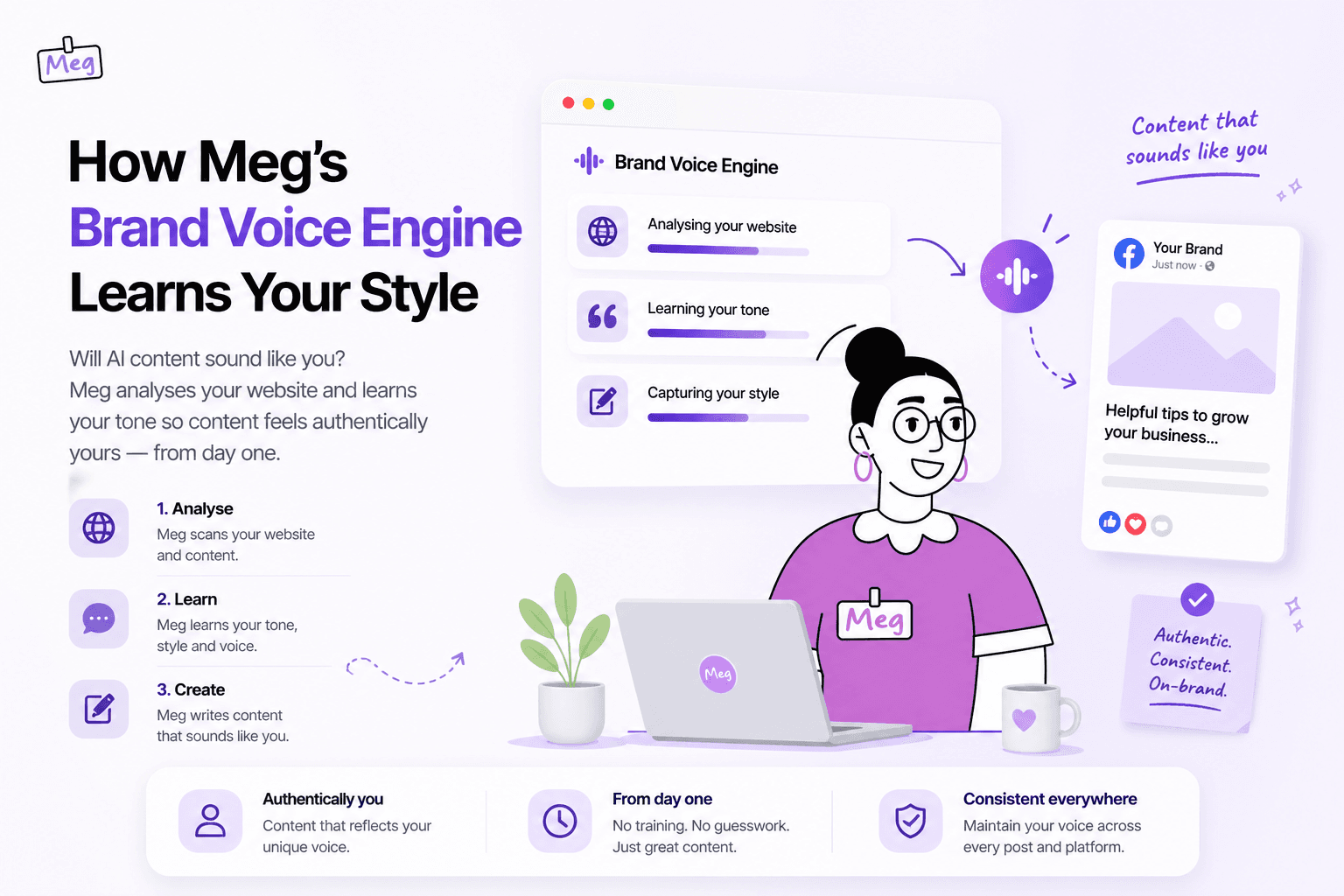
Meg's Brand Voice Engine was built specifically to solve this problem. Rather than generating generic output and hoping it's close enough, it builds a specific profile of your brand's voice before it writes a single post.
Step 1: Website Analysis and Voice Profiling
When you first sign up, Meg analyses your existing website content. She reads your About page, service descriptions, case studies, blog posts, and any other public-facing content you have. From this, she builds an initial profile of your brand: the vocabulary you use, the sentence structures you favour, the level of formality in your writing, the kinds of examples and analogies you reach for.
This initial analysis means that even from day one, Meg's output sounds noticeably more like you than generic AI content — because it's drawing on actual content you've already created rather than producing generic text.
Step 2: Onboarding Questions That Refine the Profile
The website analysis gives Meg a foundation, but your website might not reflect how you communicate on social media. During onboarding, you answer a short set of questions: who is your ideal client? What tone do you want to strike — professional and authoritative, warm and conversational, or bold and direct? Are you data-driven or more story-led? Do you prefer short punchy sentences or more developed explanations?
These answers are layered on top of the website analysis to create a more complete picture of how you communicate in different contexts. The social media voice profile is built from both sources.
Step 3: Tone Selection and Fine-Tuning
You choose from three core tone profiles — Professional, Friendly, or Bold — and can fine-tune from there with specific preferences. This sets the baseline emotional register for all generated content. A solicitor's firm and a creative agency might both choose "Professional," but their fine-tuned preferences will produce quite different outputs.
Step 4: Continuous Learning from Your Edits
Every time you edit, approve, or reject a piece of content, Meg learns. If you consistently change "utilise" to "use," she adjusts. If you always remove exclamation marks, she stops using them. If you consistently restructure the opening paragraph of LinkedIn posts in a particular way, she learns that pattern.
This continuous learning means the content improves over time. Most Meg users report that after four to six weeks of regular use, the generated content requires minimal editing — some publish it as-is. That's the goal: content that sounds like you wrote it on your best day, every single time, without the time investment of actually writing it yourself.
Step 5: Per-Platform Voice Adaptation
Your voice on LinkedIn is probably slightly more formal than on Facebook or Instagram. Meg understands this. She maintains your core brand voice while adapting the formality, length, structure, and tone for each platform's norms. The same core insight might become a structured, insight-led LinkedIn post and a more conversational Facebook update — different in execution, consistent in voice.
Why This Matters for Your Marketing
The most common objection to AI marketing tools is that the content sounds robotic and impersonal. With a generic tool, that's often true. With a voice-trained tool that learns continuously from your specific preferences, it stops being true within a few weeks.
If you're evaluating whether this is different from the AI tools you've tried before, the best way to test it is to see what Meg generates for your specific business. For a comparison of how Meg stacks up against other tools, read our guide to the best Hootsuite alternatives for small business. Or if you're ready to see it in action, see how Meg works and start your free 14-day trial.
Try Meg Free for 14 Days
The brand voice analysis takes around 15 minutes of setup. After that, Meg generates and schedules your social content automatically — in a voice that gets closer to yours with every post. No credit card required to start. See pricing and plan details here.